Blog

Instagram for business is more than a content channel
Most advice about using Instagram for business starts with the profile, posting schedule and engagement. Those things matter, but they are only the beginning for a coach, creator or digital-product business.
A Reel, Story or ad can earn attention. The business result usually happens after someone comments a keyword, replies to a Story or sends a direct message. That response begins a conversation in which the business can understand the person’s problem, decide whether the offer fits and guide them toward a purchase or call.
This creates a simple path:
Content, a Story, an ad or outreach starts a conversation.
The person handling the DMs asks questions and understands what the lead needs.
A suitable lead receives the right next step, such as a calendar link or checkout link.
The business follows up until the person books, buys or clearly decides not to continue.
The mistake is treating the first step as the whole strategy. Views, likes and comments show attention, but they do not tell you how many suitable people entered the DMs, received a useful answer or became customers.
Instagram becomes a serious business channel when you can see the complete journey from content to conversation to revenue.
The metric that changes the conversation
If your offer is sold through calls, track how many people in your DMs become qualified booked calls. If people buy directly, track how many suitable conversations become customers.
This is more useful than counting messages alone. A team can answer hundreds of DMs and still lose the people most likely to buy. The real question is not simply, How busy is the inbox? It is, How well does the inbox move the right people forward?
If Instagram already brings people into your DMs, try Mochi free for 7 days and see those conversations as a sales process instead of a list of messages.
Why the normal Instagram inbox starts to fail
A founder can usually manage the first few conversations from memory. They know who asked a question, who needs a follow-up and who said they would be ready next week.
Then the content starts working. More people reply to Stories. A Reel brings a rush of comments. The founder hires an appointment setter, commonly called a setter, to ask questions, qualify leads, follow up and book calls. Soon, several people may be working inside the same account.
At that point, four problems appear.
1. Recent messages hide important conversations
Instagram puts the newest activity near the top. That makes recency feel like priority, even though the newest message may be a compliment while a qualified lead is waiting farther down.
A person who has explained their problem, confirmed that the offer fits and asked about booking deserves attention before a random new message. When the team works from top to bottom, qualified leads can disappear underneath fresh activity.
2. Follow-ups depend on memory
An interested person may say, “Come back to me tomorrow,” or “I want to start after my trip.” With a small inbox, the founder remembers. With dozens of active conversations, that promise becomes an unread message, a note or a task somebody hopes to remember.
The lead was not rejected. The business simply failed to return at the right moment.
3. Context gets lost between replies
A lead may have shared an important detail two weeks earlier. If the next person handling the chat reads only the latest message, they may send a generic follow-up such as “Are you still interested?”
That message ignores what the person already said. It can make a warm conversation feel like nobody listened, especially when a different team member has taken over.
4. The founder sees activity, not outcomes
Message counts and end-of-day reports can show that the team was busy. They do not automatically reveal how many leads became qualified, which follow-up received replies or where suitable people stopped moving.
Without that view, the usual reaction is to demand faster replies, publish more content or buy more traffic. That can send more people into a process that is already losing good conversations.
Build a simple Instagram sales system
You do not need complicated software to improve the process today. Start by defining a small set of rules that everyone handling the inbox can follow.
Define the stages
Write down the steps a person normally moves through. A call-based business might use:
New conversation
In contact
Qualified lead
Call pitched
Calendar link sent
Booked call
Customer
A business selling directly in DMs can replace the booking stages with checkout link sent, purchase pending and customer. The labels matter less than having a shared definition for each stage.
Once the stages exist, you can find the real bottleneck. If many people qualify but few receive the calendar link, the problem is different from leads opening the booking page but not choosing a time.
Work by priority
Create a daily order for handling conversations. A practical version is:
Qualified people waiting for an answer
People who received or opened the next-step link but have not acted
Follow-ups due today
Promising new conversations
Everything else
This prevents a flood of new messages from deciding how the team spends its time. New leads still receive attention, but they no longer push the strongest existing opportunities out of sight.
Give every conversation an owner
If more than one person handles the inbox, assign one owner to each active conversation. The owner is responsible for the next reply, qualification and follow-up. This reduces duplicate messages and makes accountability clear without forcing the founder to inspect every chat.
Record the next action while the context is fresh
Do not rely on a lead remaining unread. Record when the next message should happen and what it should address. If the person replies before then, review the new message instead of sending an irrelevant prepared follow-up.
Keep useful context visible
Before replying, identify the person’s problem, goal, relevant details, objections and last agreed action. Even a short manual note helps a teammate continue the conversation without asking the lead to repeat everything.
Measure movement, not just volume
Review how many conversations moved from one stage to the next. Useful questions include:
Which content started suitable conversations?
How many new conversations became qualified?
How many qualified leads received the next-step link?
How many links became booked calls or purchases?
Which follow-ups and messages received responses?
Where did the largest group stop moving?
This review turns a vague result such as “bookings were down” into a specific problem the business can fix.
If you want qualified leads, follow-ups and booking stages to become a clear daily work list, start a 7-day free trial of Mochi and organize the conversations already inside your Instagram inbox.
When Instagram needs a dedicated DM sales system
A manual process can work while one person handles a small number of conversations. It becomes fragile when leads arrive from several posts, Stories and campaigns, or when multiple team members share the inbox.
That is where Mochi provides a stronger workflow for coaches, creators and info businesses selling through Instagram DMs.
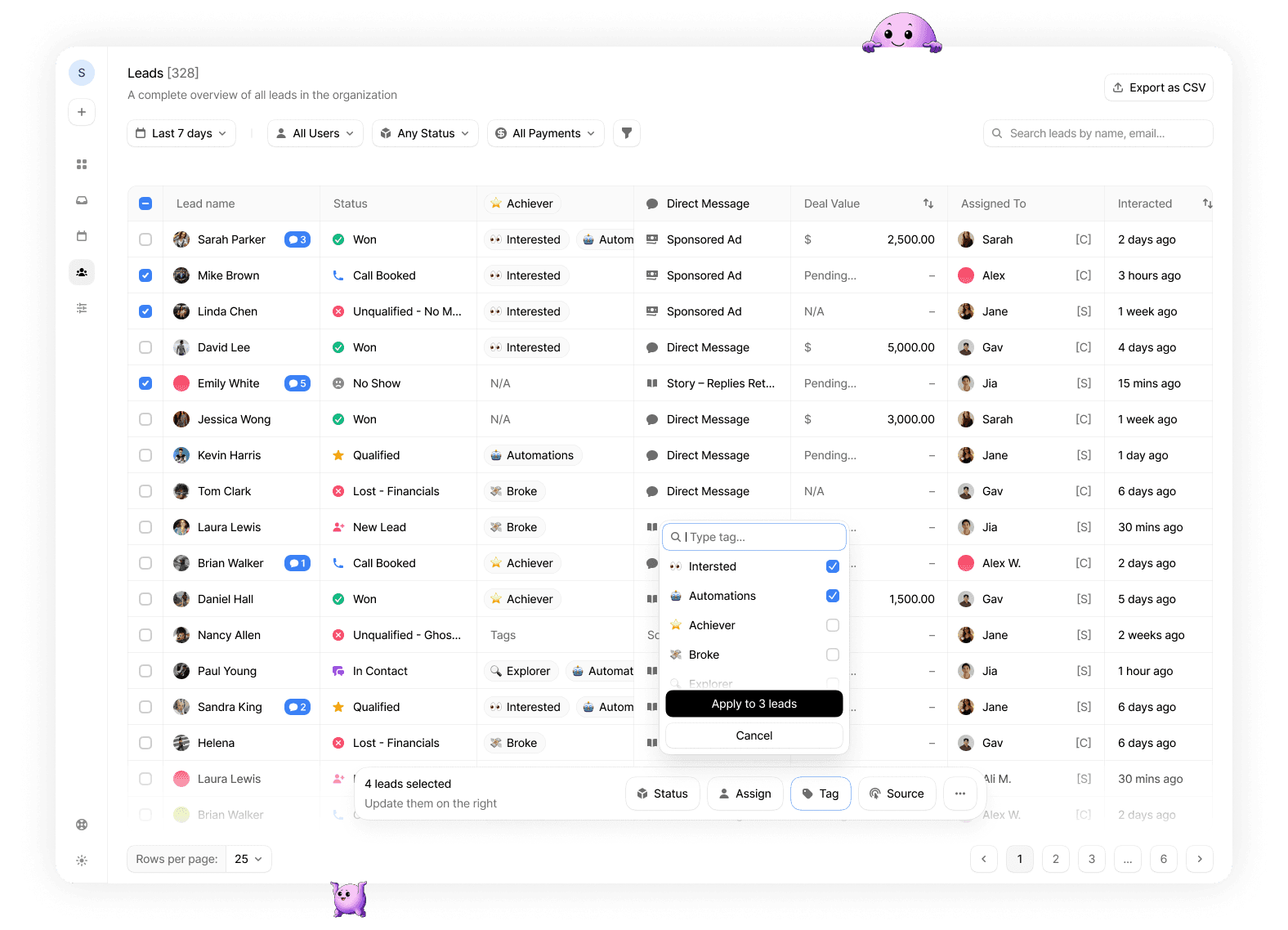
Instead of showing every conversation in a simple recent-first list, Mochi can organize the inbox around stages such as qualified, follow-up, calendar link sent, booked call and customer. Lead Filters let the team find exact groups by stage, tag, owner, date or source, while Scheduled Follow-Ups bring important conversations back at the appropriate time.
Once a calendar link is sent, Calendar Link Tracking shows whether the person received it, opened it or booked. The team can therefore follow up with the right context instead of treating every unbooked lead the same.
Custom Funnels show how people move through the business’s actual sales process. The founder can see whether the main loss happens during qualification, before the calendar link is sent or after it is opened. That makes it possible to fix the specific leak before spending more money to create additional leads.
Choose an Instagram business tool by the job it must do
Not every Instagram tool solves the same problem. Before choosing one, decide which of these jobs matters most:
Starting conversations: sending an immediate first message after a comment, keyword, Story response or ad action.
Managing conversations: assigning owners, finding qualified people, keeping context and completing follow-ups.
Running a sales pipeline: tracking qualification, next-step links, booked calls, customers and movement between stages.
Understanding results: connecting sources, scripts and team activity to qualified calls or sales.
A basic automation can be useful for starting a conversation. A serious DM sales operation also needs a reliable way to manage what happens after that first message.
A practical weekly review
Set aside time each week to review the entire path, not just public content metrics:
Identify which content and sources started conversations.
Count how many conversations became qualified.
Find qualified people still waiting for a reply or follow-up.
Check the step where the most people disappeared.
Read several conversations from that stage.
Change one part of the process and measure it again.
This creates a useful feedback loop. Content starts conversations. Conversations reveal the market’s questions and objections. The sales process shows which sources and messages move people forward. The team then uses that information to improve the next content push and the next conversation.
Instagram for business works best when attention is connected to a clear next step and every valuable conversation has an owner, context and follow-up. You may not need more leads. You may need to stop losing the good people already in your inbox.
Try Mochi free for 7 days and turn your existing Instagram DMs into a sales process your team can see and manage.

Team Chat puts your team's notes, updates, and context directly on the lead. One thread. One source of truth. No more scattered conversations.
Read more

Your inbox can now tell you who to focus on, what's junk, and which leads are about to close. This is the first step toward a self-learning inbox.
Read more

We analyzed 90 days of a coach's DMs and found their team was using their worst-converting script 6x more than their best one - because without an intelligence layer tracking every message, nobody knew.
Read more
Your setters say they're 'working all day' but you have zero proof. When one quits, 183 leads vanish into chaos. Here's how the first client reassigned every lead in 8 minutes instead of losing...
Read more

Voice messages convert at 3x the rate of text in high-ticket DM sales. But there's a problem: cloned voices sound robotic, and your leads notice. Here's how we made AI voice messages finally sound authentic at scale—using something we call Scenes.
Read more

One of our first clients found a $50K deal rotting in his DMs. The lead had been trying to buy for three weeks—just ...
Read more
Mochi handles keyword-triggered DM automation natively. Every comment, story reply, and DM trigger flows directly into your inbox, already tagged and ready for your setters.
Read more

A practical system for helping Instagram sales teams prioritize qualified leads, assign every conversation, preserve context, and follow up without losing people in the inbox.
Read more

This guide explains how Facebook ads can appear as Instagram Stories, why the DM follow-up matters more than the click, and how coaches and creators can turn story views into qualified booked calls instead of losing leads in a messy inbox.
Read more

Most Instagram marketing tools focus on reach and automation, but the real sales happen in the DMs. This guide explains what an Instagram CRM actually does, why most businesses lose qualified leads between the comment and the call, and how Mochi turns your existing inbox into a real sales channel.
Read more

Instagram ads can drive DMs, but most businesses lose leads after the click. This article explains how to fix the missing step between ad and sale.
Read more

Most brands think a good Instagram Story ad is just a pretty visual. But the real reason some Story ads make money while others just get views is the path they create after the tap. This article breaks down 7 Story ad examples, the psychology behind each, and why the smartest brands treat Story ads as the start of a DM conversation, not a dead-end link.
Read more

Instagram ads can cost less than a coffee, but the real expense is what happens after the click. This article breaks down actual ad costs and shows why the biggest loss happens in the DMs.
Read more

Most Instagram marketing advice stops at content, followers, and views. But for coaches, creators, and info businesses, the real money moves through DMs. The problem is that the Instagram inbox was built for chatting, not for sales. This article shows why your current Instagram marketing leaks leads between the first message and the booked call, and how a dedicated DM sales system helps you keep more of the people your content already brings in.
Read more

Instagram ads drive engagement, but without a proper system, those leads get lost in the DMs. This article explains why an Instagram ads manager needs a CRM to track leads from comment to customer and how Mochi helps close the gap.
Read more

A practical guide to planning, launching and improving Instagram ads, with a focus on turning clicks and DM conversations into qualified leads, booked calls and customers.
Read more

A practical guide to affiliate marketing with Instagram for creators who want to turn relevant content and DM conversations into measurable affiliate sales without relying on follower count alone.
Read more

A practical guide for coaches, creators and digital-product businesses choosing an Instagram growth service. Learn what to measure, which warning signs to avoid and how to turn new attention into qualified conversations, booked calls and customers.
Read more

An Instagram business account can attract leads, start conversations and support sales. This guide explains how to organize the journey from content to DM to customer, including when a dedicated Instagram DM sales system becomes useful.
Read more

ManyChat is useful for starting and automating conversations, but an Instagram DM sales team may need more than a first-message flow. This guide explains how to choose an alternative based on the full journey from comment or Story reply to qualified lead, booked call and customer.
Read more

A practical guide for coaches, creators and digital-product businesses evaluating a Zendesk chatbot or another conversational tool for Instagram DM sales. It explains how to assess the complete journey from first message to qualified lead, booked call and customer.
Read more

The best ManyChat alternative depends on what must happen after a conversation starts. This guide compares six options by use case and explains what Instagram-led sales teams should evaluate before switching.
Read more

A practical guide to choosing among website chat, shared inbox, automation and Instagram DM sales tools based on where conversations begin and what must happen next.
Read more

The best ManyChat competitor depends on what needs to happen after someone enters your DMs. This guide compares the main tool categories and explains how to choose between simple automation, multichannel support and a dedicated Instagram DM sales system.
Read more

The best Chatbase alternative depends on where conversations happen and what should happen next. This guide gives you a practical framework for comparing tools, with a closer look at Instagram DM sales for coaches, creators and digital-product businesses.
Read more

This practical ManyChat example shows how a comment-to-DM automation starts an Instagram conversation, why the first message is only one part of the sales journey and how to manage the lead through qualification, follow-up and booking.
Read more

The right Chatib alternative depends on what you want conversations to accomplish. This guide explains how to compare casual chat, customer support, automation and Instagram DM sales tools, including when Mochi is the more relevant choice.
Read more

The best Chatrandom alternative depends on the conversation you want to have. This guide explains how to evaluate random video chat services, community platforms, and business messaging systems without treating fundamentally different tools as interchangeable.
Read more

Chatfuel pricing research points to plans starting at $69 per month, but the right decision depends on more than the headline fee. This guide explains how to assess total cost, channel fit and what happens after an automated conversation begins.
Read more

The right Chatwoot alternative depends on the job you need it to do. For coaches, creators and digital-product businesses selling through Instagram DMs, the important question is whether the system can help the team find qualified leads, continue conversations with context and see what produces booked calls or customers.
Read more

ManyChat and Chatfuel both help businesses automate messaging, but the better choice depends on the channels you use and the job you need the tool to perform. This guide also explains why Instagram sellers should evaluate the sales process after the first automated message.
Read more

An Instagram account QR code gives people a quick way to open your profile without searching for your username. This guide explains how to find, share, print and scan your code, then shows businesses how to turn the resulting profile visits and DMs into a clear lead-management process.
Read more

A practical guide for coaches and creators who want to move beyond simply being visible on Instagram and build a clear process for managing the conversations their content creates.
Read more

A practical guide to scheduling Instagram posts with a repeatable content plan, clear calls to action and a system for handling the DM conversations that follow.
Read more

An Instagram QR code gives people a quick route from a physical location, presentation or screen to your profile. This guide explains how to access and test your code, where to place it and how to turn scans into DM conversations your team can manage.
Read more

Instagram Creator Studio searches often begin with content planning, publishing and performance. But creators who sell through Instagram also need a clear system for handling the conversations that content creates. This guide explains how to connect content operations with lead priority, follow-up, attribution and booked-call tracking.
Read more

Instagram posts can be scheduled, but publishing on time is only half the job. This guide explains how to build a practical content schedule and prepare for the comments, DMs and sales conversations that follow.
Read more

A practical guide to finding an official Instagram logo with a transparent background, checking the file before use and placing it cleanly across websites, presentations and social media graphics.
Read more

Making money on Instagram is less about collecting views and more about connecting the right audience to a clear offer. This guide explains the main income models, how to build a simple content-to-DM sales system and how to stop interested people from disappearing before they buy.
Read more

Instagram sponsored posts can put proven content in front of more potential customers, but reach alone does not create revenue. This guide explains how to choose the right post, give people a clear next step and manage the DM conversations that follow.
Read more

An Instagram CRM organizes DM conversations around leads, follow-ups and sales outcomes. This guide explains what a useful system should track, how to improve your process manually and where Mochi creates a stronger workflow for coaches, creators and digital-product businesses.
Read more

A practical guide to choosing and using a CRM for Instagram DMs, with a clear checklist for managing leads, follow-ups, conversations, booked calls, attribution, and team performance.
Read more

ManyChat can help coaches and creators start Instagram DM conversations from comments, Stories and other triggers. These seven examples show what to automate, what should stay human and how to manage the sales work that begins after the first message.
Read more

A practical guide to Instagram ad dimensions, aspect ratios and safe design choices, plus a simple workflow for turning ad-driven DMs into qualified conversations.
Read more

A practical guide to fixing a black screen in Instagram messages, from checking for an outage and restarting the app to clearing local app data and reporting the problem. It also explains how businesses can reduce the sales disruption caused by relying on a crowded Instagram inbox.
Read more

Instagram lets you remove a message from a conversation, but unsending cannot guarantee that nobody saw it. This guide explains the basic process, the difference between unsending and deleting a chat, and a safer DM workflow for businesses.
Read more

“SMS Instagram” usually refers to messaging someone through Instagram, but Instagram Direct Messages are different from phone-based SMS. This guide explains that difference, shows where Instagram DM automation helps and outlines a practical system for moving conversations from the first message to a booked call or sale.
Read more

A practical guide to opening Instagram DMs, finding message requests, fixing common loading problems and building a better process when your inbox becomes a sales channel.
Read more

An urgent copyright warning that moves you from Instagram to WhatsApp may be a phishing attempt. This guide explains the warning signs, the safest way to verify a notice and the steps to take if you already clicked or shared information.
Read more

A practical guide to deleting Instagram DM conversations, unsending individual messages and cleaning up a business inbox without accidentally losing useful lead context.
Read more

Deleting a chat removes it from your inbox, while unsending removes a message you sent from the conversation. This guide explains both options and shows businesses a safer way to clean up busy Instagram DMs.
Read more

A practical guide to replying to Instagram DMs, with a simple response framework, ready-to-adapt examples and a better system for managing leads as message volume grows.
Read more

Chatfuel can help businesses automate the beginning of social conversations, but coaches and creators should also examine what happens after the first message. This guide explains how to assess Chatfuel against the complete Instagram DM sales journey.
Read more

To remove a full Instagram conversation from your own inbox, delete the chat. To remove one message you sent from the conversation for everyone, use Unsend. This guide explains both options, their limits and a safer way for businesses to manage a crowded sales inbox.
Read more

An Instagram QR code gives people a quick route from a physical or digital touchpoint to your profile. This guide explains how to find and share yours, where to place it, and how to build a clear path from the scan to a DM conversation your team can manage.
Read more

Instagram ads do not have one fixed price. This guide explains how the auction, campaign choices and sales process affect what you pay, then shows how to build a budget around qualified conversations and customers instead of cheap clicks alone.
Read more

Instagram ads do not have one fixed price. This guide explains the auction, the factors that influence costs, how to set a sensible test budget and why businesses should measure the full journey from ad to DM, qualified lead, booked call and customer.
Read more

Instagram sponsored ads can create attention, clicks and DM conversations, but the ad is only the beginning. This guide explains how to build a complete path from paid attention to qualified leads, booked calls and customers.
Read more

The right alternative chat system depends on what happens after a person enters your Instagram DMs. This guide explains how to assess automation, lead priority, follow-up, conversation context and sales reporting before choosing a tool.
Read more

A business Instagram account can attract attention, start conversations and create sales. This guide explains how coaches, creators and digital-product businesses can turn their account’s DMs into a clear sales process without losing qualified leads in a busy inbox.
Read more

Instagram Stories can be scheduled with Instagram-supported publishing tools or compatible third-party tools, although publishing options can vary by account and Story element. This guide explains how to prepare a Story sequence, check it before it goes live and build a process for handling the replies and leads it creates.
Read more

Deleted, unsent and temporarily missing Instagram messages are not the same thing. This guide explains how to identify what happened, check the places where a conversation may still exist and protect important business DMs before they disappear from your workflow.
Read more

The ManyChat API can help connect a messaging workflow with other business systems, but the connection itself is not a complete Instagram DM sales process. This guide explains how to define the job before building, evaluate the handoff from automation to a human team and make sure qualified conversations remain visible through follow-up and booking.
Read more

A practical guide for coaches, creators and digital-product businesses comparing a ManyChat promotion with the wider system needed to turn Instagram conversations into qualified booked calls or customers.
Read more

A practical Instagram Story ad framework for coaches, creators and digital-product businesses. Learn how to move from a clear problem and useful offer to a DM conversation, then manage and measure what happens after the reply.
Read more

Instagram lead gen ads can create attention quickly, but the real result depends on what happens after someone responds. This guide explains how coaches, creators and digital-product businesses can connect ads to fast replies, useful qualification, consistent follow-up and a measurable DM sales process.
Read more

Instagram lead ads can create interest, but the real sales work starts after someone responds. This guide explains how coaches, creators and digital-product businesses can build a clear system for qualifying, prioritizing, following up with and measuring leads from Instagram ads.
Read more

Lead ads on Instagram work best when the campaign is designed around the complete journey from ad response to qualified conversation, follow-up, booked call and customer. This guide explains how to build that system and measure the outcomes that matter.
Read more

The best ManyChat alternative depends on what must happen after an Instagram user comments, replies or enters your DMs. This guide compares the main tool categories and explains when Mochi is the stronger choice for an Instagram DM sales operation.
Read more

To remove a message you sent from an Instagram chat, press and hold it on mobile or open its options on desktop, then choose Unsend. Deleting an entire conversation is different: it clears the chat from your inbox but does not remove it from the other participants’ inboxes.
Read more

A practical guide for coaches, creators and digital-product businesses deciding whether they need a chatbot, a support system or a dedicated Instagram DM sales system. It explains how to evaluate conversation entry, qualification, follow-up, context and sales visibility before choosing a tool.
Read more

ManyChat is useful for starting and automating conversations, but some Instagram-led businesses need a system for what happens next. This guide explains how to choose an alternative based on whether you need automation, customer support or a complete DM sales workflow.
Read more

The best ManyChat alternative depends on whether you need to trigger messages, support customers across channels or turn Instagram conversations into qualified calls and sales. This guide explains the differences and shows what to evaluate before switching.
Read more