Blog

ManyChat may solve the first step, but what happens next?
A creator posts a Reel and asks people to comment a word to receive a guide. The comments arrive, an automation sends the guide and new conversations open inside Instagram. This is the job many people associate with ManyChat: starting and automating conversations from comments, Stories and other triggers.
That first response matters. If dozens of people ask for something, they should not have to wait for someone to send the same message manually. But for a coach, creator or digital-product business, delivering the first DM is rarely the complete sales process.
Someone still needs to understand the lead, ask useful questions, decide whether the offer fits, follow up and move the right person toward a call or purchase. When many conversations are active, the difficult part is no longer opening the chat. It is managing everything that happens after the chat opens.
This distinction should guide any search for a ManyChat alternative. Do not begin with the longest feature list or the lowest advertised price. Begin with the job your business actually needs the tool to perform.
Three different jobs are often grouped together
Conversation automation: Trigger a DM, deliver a resource or route someone through a predefined flow.
Customer communication: Answer questions and manage conversations across one or more channels.
DM sales management: Qualify leads, assign ownership, complete follow-ups, track booking steps and understand which conversations create customers.
A tool can be strong at one job without being the best fit for the others. ManyChat is useful for starting and automating conversations. If your main need is a simple comment-to-DM flow, replacing it with a larger sales system may add complexity you do not need.
If conversations are already starting but qualified people are being forgotten, however, another automation flow will not fix the real problem. You need to see and manage the journey after the first message.
If that is the gap in your current setup, try Mochi free for 7 days and use it with the leads already entering your Instagram DMs.
How to know whether you need a ManyChat alternative
The clearest signal is not that you dislike your current tool. It is that the business has outgrown the job that tool was chosen to do.
At first, success may mean sending a promised resource immediately. Later, the business needs to answer harder questions: Who replied? Who is a good fit? Who asked about the offer? Who received the calendar link? Who opened it but did not book? Which Story created qualified leads rather than casual replies?
Look for these signs inside your current process
Qualified conversations disappear under new messages. Instagram puts recent activity at the top. A new compliment can appear above someone who already answered the qualifying questions and wants to book.
Follow-ups depend on memory. Team members leave chats unread, write separate notes or hope they will remember to return tomorrow. New messages arrive, and interested people disappear.
Every handoff loses context. A lead explains their situation to one person, then receives a generic reply from someone else because the second person did not read the full history.
Sending the calendar link is treated as the result. The team knows a link was sent but cannot clearly separate people who never opened it, people who opened it and people who booked.
Activity is visible, but outcomes are not. Reports count messages and replies without showing which conversations became qualified leads, booked calls or customers.
Content and sales data stay separate. The content team sees views and comments while the sales team sees DMs and bookings. The founder has to guess which post created the valuable conversations.
These are not simply automation problems. They are signs that Instagram has become a real sales channel but is still being managed like a normal inbox.
You can improve the process manually before changing tools. Define the stages a conversation moves through. Give each chat one owner. Create a daily list for qualified leads and follow-ups. Record whether calendar links were sent and whether calls were booked. Review outcomes instead of only message counts.
This manual process is useful because it exposes what your software must support. It also prevents you from buying another tool before you understand the actual leak.
What to compare in a ManyChat alternative for Instagram
Search results for ManyChat alternatives often group together chatbot builders, low-cost comment automation tools, customer-support inboxes and broader messaging platforms. Those categories can all be useful, but they solve different problems. Use the following questions to make a fair comparison.
1. Does it only start the conversation?
Ask what happens after a comment or keyword triggers the first message. Can the team continue the conversation in the same system? Can it distinguish a new reply from a qualified lead, a follow-up or someone close to booking?
2. Can the team work by priority?
The newest message is not always the most valuable one. Look for a way to find conversations by stage, owner, source, date or useful lead information. The goal is to turn the inbox into a clear work list instead of asking the team to scroll from top to bottom.
3. Does it preserve context?
A strong sales conversation should show that somebody listened. Consider whether a new team member can quickly understand the lead's problem, goal, objections and previous steps without reading weeks of messages.
4. Can it manage follow-up properly?
Follow-up should not live inside someone's head. Check whether the system can bring a conversation back at the right time and avoid sending a scheduled message when the person has already replied.
5. Does it track the booking journey?
Sending a calendar link is not the finish line. A useful system should help the team understand what happened afterward so the right people receive the right follow-up.
6. Can it show the complete DM sales pipeline?
Define the stages your business uses, such as new lead, in contact, qualified, calendar link sent, link clicked, booked call and customer. Then ask whether the tool shows how people move between them. Without this view, a low booking rate remains one unexplained number.
7. Can it connect sources to outcomes?
A Reel with fewer views may produce more qualified leads than a viral post. If content drives your sales conversations, compare tools by whether they connect the original Story, post, ad or outbound message to qualified leads, booked calls and customers.
8. Can managers see team outcomes?
Sending many messages is activity, not necessarily performance. A manager should be able to see who completes follow-ups, qualifies the right people and creates qualified booked calls, then inspect the conversations when coaching is needed.
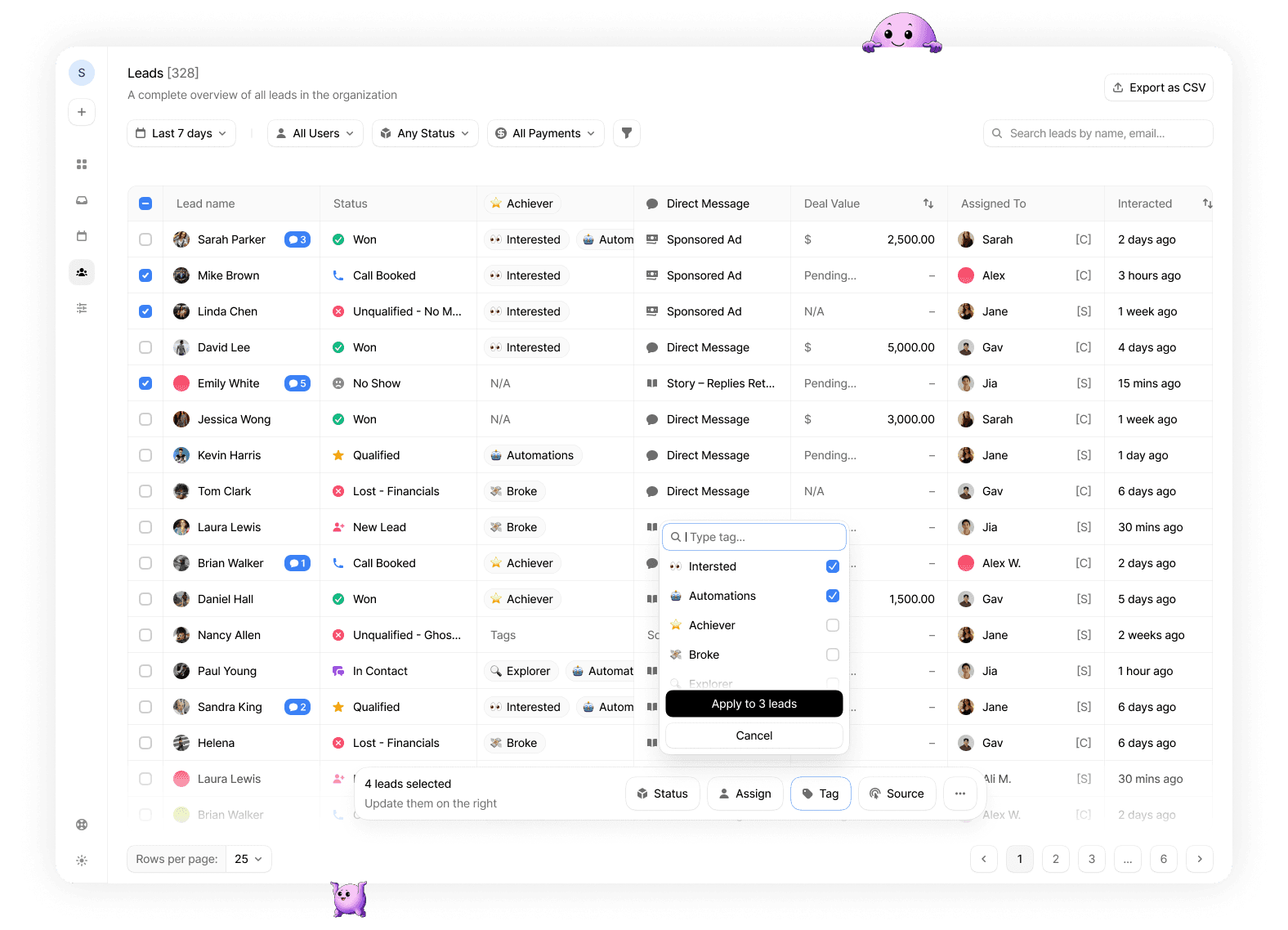
Mochi is designed around this part of the journey. It can start selected conversations, but its main role is helping a coach, creator or digital-product business run the Instagram DM sales operation after and around the first message. The team can organize conversations by priority, use the context already inside each chat, complete follow-ups and see how leads move toward calls and customers.
If you want to compare that workflow with a basic automation-first setup, start a 7-day free trial of Mochi and test it with real conversations from your business.
Should you replace ManyChat, keep it or use it with Mochi?
You do not need to replace a working system simply because another tool exists. Choose the smallest change that solves the business problem.
Keep ManyChat when automation is the main job
If you mainly need to trigger a first response, deliver a resource or run established flows, your current setup may already be doing what you need. Improve the message and measure whether people continue the conversation before adding more software.
Use ManyChat with Mochi when your flows work but sales management does not
A business can keep the automations it already uses and manage the conversations that follow inside Mochi. This route makes sense when the first message arrives correctly but the team needs clearer ownership, lead priority, context, follow-up and visibility into booked calls.
Move more of the process into Mochi when Instagram DMs are a sales channel
If your goal is to manage the path from new conversation to qualified lead, booked call and customer in one dedicated Instagram DM sales system, Mochi can also start selected conversations. The important decision is not which product has more features. It is whether the system matches the journey your team needs to manage.
A simple decision checklist
Choose an automation-focused tool when the main need is starting and routing conversations.
Choose a support or omnichannel tool when the main need is handling customer questions across several channels.
Choose a DM sales system when the main need is prioritizing leads, maintaining context, completing follow-ups and tracking calls or sales from Instagram.
Use connected tools when each one already performs a distinct job well and changing everything would create unnecessary work.
The wrong question is, “What is the best ManyChat alternative for everyone?” The useful question is, “Where does our Instagram DM process break after someone starts talking to us?”
If good leads are already entering the inbox but the team cannot consistently find, follow up with and move them forward, you may not need more attention. You need to stop losing the attention you already earned.
Try Mochi free for 7 days to organize your existing Instagram conversations and see the journey from new lead to booked call more clearly.

Team Chat puts your team's notes, updates, and context directly on the lead. One thread. One source of truth. No more scattered conversations.
Read more

Your inbox can now tell you who to focus on, what's junk, and which leads are about to close. This is the first step toward a self-learning inbox.
Read more

We analyzed 90 days of a coach's DMs and found their team was using their worst-converting script 6x more than their best one - because without an intelligence layer tracking every message, nobody knew.
Read more
Your setters say they're 'working all day' but you have zero proof. When one quits, 183 leads vanish into chaos. Here's how the first client reassigned every lead in 8 minutes instead of losing...
Read more

Voice messages convert at 3x the rate of text in high-ticket DM sales. But there's a problem: cloned voices sound robotic, and your leads notice. Here's how we made AI voice messages finally sound authentic at scale—using something we call Scenes.
Read more

One of our first clients found a $50K deal rotting in his DMs. The lead had been trying to buy for three weeks—just ...
Read more
Mochi handles keyword-triggered DM automation natively. Every comment, story reply, and DM trigger flows directly into your inbox, already tagged and ready for your setters.
Read more

A practical system for helping Instagram sales teams prioritize qualified leads, assign every conversation, preserve context, and follow up without losing people in the inbox.
Read more

This guide explains how Facebook ads can appear as Instagram Stories, why the DM follow-up matters more than the click, and how coaches and creators can turn story views into qualified booked calls instead of losing leads in a messy inbox.
Read more

Most Instagram marketing tools focus on reach and automation, but the real sales happen in the DMs. This guide explains what an Instagram CRM actually does, why most businesses lose qualified leads between the comment and the call, and how Mochi turns your existing inbox into a real sales channel.
Read more

Instagram ads can drive DMs, but most businesses lose leads after the click. This article explains how to fix the missing step between ad and sale.
Read more

Most brands think a good Instagram Story ad is just a pretty visual. But the real reason some Story ads make money while others just get views is the path they create after the tap. This article breaks down 7 Story ad examples, the psychology behind each, and why the smartest brands treat Story ads as the start of a DM conversation, not a dead-end link.
Read more

Instagram ads can cost less than a coffee, but the real expense is what happens after the click. This article breaks down actual ad costs and shows why the biggest loss happens in the DMs.
Read more

Most Instagram marketing advice stops at content, followers, and views. But for coaches, creators, and info businesses, the real money moves through DMs. The problem is that the Instagram inbox was built for chatting, not for sales. This article shows why your current Instagram marketing leaks leads between the first message and the booked call, and how a dedicated DM sales system helps you keep more of the people your content already brings in.
Read more

Instagram ads drive engagement, but without a proper system, those leads get lost in the DMs. This article explains why an Instagram ads manager needs a CRM to track leads from comment to customer and how Mochi helps close the gap.
Read more

A practical guide to planning, launching and improving Instagram ads, with a focus on turning clicks and DM conversations into qualified leads, booked calls and customers.
Read more

A practical guide to affiliate marketing with Instagram for creators who want to turn relevant content and DM conversations into measurable affiliate sales without relying on follower count alone.
Read more

A practical guide for coaches, creators and digital-product businesses choosing an Instagram growth service. Learn what to measure, which warning signs to avoid and how to turn new attention into qualified conversations, booked calls and customers.
Read more

An Instagram business account can attract leads, start conversations and support sales. This guide explains how to organize the journey from content to DM to customer, including when a dedicated Instagram DM sales system becomes useful.
Read more

Instagram can create attention and start valuable conversations, but a busy inbox is not a sales system. This guide explains how coaches, creators and digital-product businesses can connect content to DMs, qualify leads, prioritize follow-ups and measure the path to booked calls or customers.
Read more

A practical guide for coaches, creators and digital-product businesses evaluating a Zendesk chatbot or another conversational tool for Instagram DM sales. It explains how to assess the complete journey from first message to qualified lead, booked call and customer.
Read more

The best ManyChat alternative depends on what must happen after a conversation starts. This guide compares six options by use case and explains what Instagram-led sales teams should evaluate before switching.
Read more

A practical guide to choosing among website chat, shared inbox, automation and Instagram DM sales tools based on where conversations begin and what must happen next.
Read more

The best ManyChat competitor depends on what needs to happen after someone enters your DMs. This guide compares the main tool categories and explains how to choose between simple automation, multichannel support and a dedicated Instagram DM sales system.
Read more

The best Chatbase alternative depends on where conversations happen and what should happen next. This guide gives you a practical framework for comparing tools, with a closer look at Instagram DM sales for coaches, creators and digital-product businesses.
Read more

This practical ManyChat example shows how a comment-to-DM automation starts an Instagram conversation, why the first message is only one part of the sales journey and how to manage the lead through qualification, follow-up and booking.
Read more

The right Chatib alternative depends on what you want conversations to accomplish. This guide explains how to compare casual chat, customer support, automation and Instagram DM sales tools, including when Mochi is the more relevant choice.
Read more

The best Chatrandom alternative depends on the conversation you want to have. This guide explains how to evaluate random video chat services, community platforms, and business messaging systems without treating fundamentally different tools as interchangeable.
Read more

Chatfuel pricing research points to plans starting at $69 per month, but the right decision depends on more than the headline fee. This guide explains how to assess total cost, channel fit and what happens after an automated conversation begins.
Read more

The right Chatwoot alternative depends on the job you need it to do. For coaches, creators and digital-product businesses selling through Instagram DMs, the important question is whether the system can help the team find qualified leads, continue conversations with context and see what produces booked calls or customers.
Read more

ManyChat and Chatfuel both help businesses automate messaging, but the better choice depends on the channels you use and the job you need the tool to perform. This guide also explains why Instagram sellers should evaluate the sales process after the first automated message.
Read more

An Instagram account QR code gives people a quick way to open your profile without searching for your username. This guide explains how to find, share, print and scan your code, then shows businesses how to turn the resulting profile visits and DMs into a clear lead-management process.
Read more

A practical guide for coaches and creators who want to move beyond simply being visible on Instagram and build a clear process for managing the conversations their content creates.
Read more

A practical guide to scheduling Instagram posts with a repeatable content plan, clear calls to action and a system for handling the DM conversations that follow.
Read more

An Instagram QR code gives people a quick route from a physical location, presentation or screen to your profile. This guide explains how to access and test your code, where to place it and how to turn scans into DM conversations your team can manage.
Read more

Instagram Creator Studio searches often begin with content planning, publishing and performance. But creators who sell through Instagram also need a clear system for handling the conversations that content creates. This guide explains how to connect content operations with lead priority, follow-up, attribution and booked-call tracking.
Read more

Instagram posts can be scheduled, but publishing on time is only half the job. This guide explains how to build a practical content schedule and prepare for the comments, DMs and sales conversations that follow.
Read more

A practical guide to finding an official Instagram logo with a transparent background, checking the file before use and placing it cleanly across websites, presentations and social media graphics.
Read more

Making money on Instagram is less about collecting views and more about connecting the right audience to a clear offer. This guide explains the main income models, how to build a simple content-to-DM sales system and how to stop interested people from disappearing before they buy.
Read more

Instagram sponsored posts can put proven content in front of more potential customers, but reach alone does not create revenue. This guide explains how to choose the right post, give people a clear next step and manage the DM conversations that follow.
Read more

An Instagram CRM organizes DM conversations around leads, follow-ups and sales outcomes. This guide explains what a useful system should track, how to improve your process manually and where Mochi creates a stronger workflow for coaches, creators and digital-product businesses.
Read more

A practical guide to choosing and using a CRM for Instagram DMs, with a clear checklist for managing leads, follow-ups, conversations, booked calls, attribution, and team performance.
Read more

ManyChat can help coaches and creators start Instagram DM conversations from comments, Stories and other triggers. These seven examples show what to automate, what should stay human and how to manage the sales work that begins after the first message.
Read more

A practical guide to Instagram ad dimensions, aspect ratios and safe design choices, plus a simple workflow for turning ad-driven DMs into qualified conversations.
Read more

A practical guide to fixing a black screen in Instagram messages, from checking for an outage and restarting the app to clearing local app data and reporting the problem. It also explains how businesses can reduce the sales disruption caused by relying on a crowded Instagram inbox.
Read more

Instagram lets you remove a message from a conversation, but unsending cannot guarantee that nobody saw it. This guide explains the basic process, the difference between unsending and deleting a chat, and a safer DM workflow for businesses.
Read more

“SMS Instagram” usually refers to messaging someone through Instagram, but Instagram Direct Messages are different from phone-based SMS. This guide explains that difference, shows where Instagram DM automation helps and outlines a practical system for moving conversations from the first message to a booked call or sale.
Read more

A practical guide to opening Instagram DMs, finding message requests, fixing common loading problems and building a better process when your inbox becomes a sales channel.
Read more

An urgent copyright warning that moves you from Instagram to WhatsApp may be a phishing attempt. This guide explains the warning signs, the safest way to verify a notice and the steps to take if you already clicked or shared information.
Read more

A practical guide to deleting Instagram DM conversations, unsending individual messages and cleaning up a business inbox without accidentally losing useful lead context.
Read more

Deleting a chat removes it from your inbox, while unsending removes a message you sent from the conversation. This guide explains both options and shows businesses a safer way to clean up busy Instagram DMs.
Read more

A practical guide to replying to Instagram DMs, with a simple response framework, ready-to-adapt examples and a better system for managing leads as message volume grows.
Read more

Chatfuel can help businesses automate the beginning of social conversations, but coaches and creators should also examine what happens after the first message. This guide explains how to assess Chatfuel against the complete Instagram DM sales journey.
Read more

To remove a full Instagram conversation from your own inbox, delete the chat. To remove one message you sent from the conversation for everyone, use Unsend. This guide explains both options, their limits and a safer way for businesses to manage a crowded sales inbox.
Read more

An Instagram QR code gives people a quick route from a physical or digital touchpoint to your profile. This guide explains how to find and share yours, where to place it, and how to build a clear path from the scan to a DM conversation your team can manage.
Read more

Instagram ads do not have one fixed price. This guide explains how the auction, campaign choices and sales process affect what you pay, then shows how to build a budget around qualified conversations and customers instead of cheap clicks alone.
Read more

Instagram ads do not have one fixed price. This guide explains the auction, the factors that influence costs, how to set a sensible test budget and why businesses should measure the full journey from ad to DM, qualified lead, booked call and customer.
Read more

Instagram sponsored ads can create attention, clicks and DM conversations, but the ad is only the beginning. This guide explains how to build a complete path from paid attention to qualified leads, booked calls and customers.
Read more

The right alternative chat system depends on what happens after a person enters your Instagram DMs. This guide explains how to assess automation, lead priority, follow-up, conversation context and sales reporting before choosing a tool.
Read more

A business Instagram account can attract attention, start conversations and create sales. This guide explains how coaches, creators and digital-product businesses can turn their account’s DMs into a clear sales process without losing qualified leads in a busy inbox.
Read more

Instagram Stories can be scheduled with Instagram-supported publishing tools or compatible third-party tools, although publishing options can vary by account and Story element. This guide explains how to prepare a Story sequence, check it before it goes live and build a process for handling the replies and leads it creates.
Read more

Deleted, unsent and temporarily missing Instagram messages are not the same thing. This guide explains how to identify what happened, check the places where a conversation may still exist and protect important business DMs before they disappear from your workflow.
Read more

The ManyChat API can help connect a messaging workflow with other business systems, but the connection itself is not a complete Instagram DM sales process. This guide explains how to define the job before building, evaluate the handoff from automation to a human team and make sure qualified conversations remain visible through follow-up and booking.
Read more

A practical guide for coaches, creators and digital-product businesses comparing a ManyChat promotion with the wider system needed to turn Instagram conversations into qualified booked calls or customers.
Read more

A practical Instagram Story ad framework for coaches, creators and digital-product businesses. Learn how to move from a clear problem and useful offer to a DM conversation, then manage and measure what happens after the reply.
Read more

Instagram lead gen ads can create attention quickly, but the real result depends on what happens after someone responds. This guide explains how coaches, creators and digital-product businesses can connect ads to fast replies, useful qualification, consistent follow-up and a measurable DM sales process.
Read more

Instagram lead ads can create interest, but the real sales work starts after someone responds. This guide explains how coaches, creators and digital-product businesses can build a clear system for qualifying, prioritizing, following up with and measuring leads from Instagram ads.
Read more

Lead ads on Instagram work best when the campaign is designed around the complete journey from ad response to qualified conversation, follow-up, booked call and customer. This guide explains how to build that system and measure the outcomes that matter.
Read more

The best ManyChat alternative depends on what must happen after an Instagram user comments, replies or enters your DMs. This guide compares the main tool categories and explains when Mochi is the stronger choice for an Instagram DM sales operation.
Read more

To remove a message you sent from an Instagram chat, press and hold it on mobile or open its options on desktop, then choose Unsend. Deleting an entire conversation is different: it clears the chat from your inbox but does not remove it from the other participants’ inboxes.
Read more

A practical guide for coaches, creators and digital-product businesses deciding whether they need a chatbot, a support system or a dedicated Instagram DM sales system. It explains how to evaluate conversation entry, qualification, follow-up, context and sales visibility before choosing a tool.
Read more

ManyChat is useful for starting and automating conversations, but some Instagram-led businesses need a system for what happens next. This guide explains how to choose an alternative based on whether you need automation, customer support or a complete DM sales workflow.
Read more

The best ManyChat alternative depends on whether you need to trigger messages, support customers across channels or turn Instagram conversations into qualified calls and sales. This guide explains the differences and shows what to evaluate before switching.
Read more